
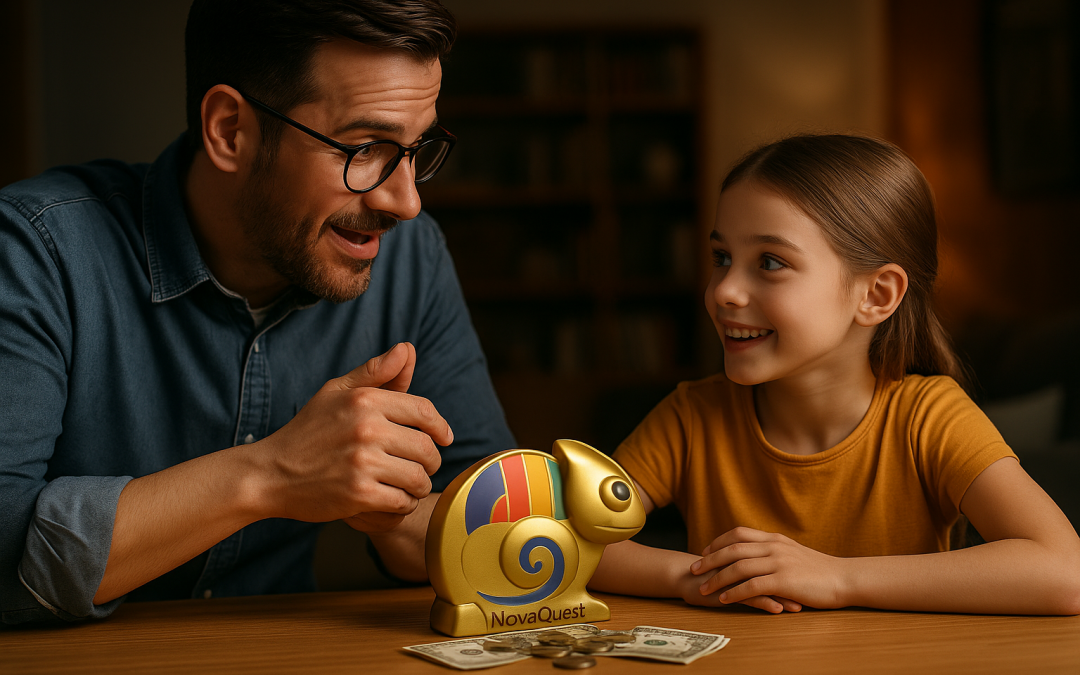
Avoiding the Money Traps We Fall Into as Adults
Most of us learnt about money the hard way.
Not from school, but from mistakes: a credit card we shouldn’t have opened, a raise we spent too quickly, or that time we thought a loan was “free money”.
Now we want our kids to have a different experience.
But where do we start?
The truth is, money habits are learnt at home.
Kids don’t need a finance degree to understand value.
They need examples, routines, and conversations.
Let’s look at the six most common money traps adults fall into and how we can turn each one into a life lesson for our children.
1. The Lifestyle Creep Trap
It’s what happens when every pay raise becomes a reason to spend more.
A bigger house, a newer car, the latest phone, another subscription.
It feels like progress, but it quietly keeps us from building wealth.
-> What to teach your kids:
Happiness doesn’t come from having more; it comes from using what you have wisely.
When your child gets money (a gift, allowance, or from selling something), help them divide it: a little for spending, a little for saving, and a little for giving.
Research from the OECD (2023) shows that children who learn to allocate small amounts of money early develop stronger budgeting and planning habits as adults.
2. The High-Interest Debt Trap
Credit cards and easy loans can feel like freedom until interest compounds.
Paying the minimum is like running on a treadmill that never stops.
-> What to teach your kids:
Money borrowed must always be returned to the bank.
Even young children can understand this through examples: if you borrow a toy, you return it in good condition.
For teens, explain credit as a tool, not a gift.
According to the FINRA Foundation (2023), 46% of adults carry credit card debt month to month.
Teaching kids about responsible borrowing reduces this risk later in life.
3. The “No Budget” Trap
Without a plan, money disappears.
We spend without realising where it went, and the cycle repeats.
-> What to teach your kids:
Make budgeting a family activity.
Show them how you track expenses, or let them plan a family dinner on a small budget.
Let them see the real numbers. The goal isn’t perfection; it’s awareness.
The Journal of Family and Economic Issues (2021) found that children whose parents discuss financial decisions regularly are more likely to manage money effectively as adults.
4. The “I’ll Invest Later” Trap
The most expensive words in personal finance are “I’ll start later.”
Delaying investment in skills, savings, and the future costs years of compound growth.
-> What to teach your kids:
Show them how time multiplies effort.
You can do this with a small jar for saving coins or by tracking a small “investment” in something they care about (a hobby, a small business project, or even learning a new skill).
Harvard Graduate School of Education (2016) found that children who learn delayed gratification through saving and waiting exercises develop stronger emotional regulation and persistence.
5. The “No Safety Net” Trap
Emergencies happen.
Job loss, illness, or even just a broken laptop.
Without an emergency fund, families end up relying on debt.
-> What to teach your kids:
Explain the idea of “saving for surprises”.
It’s not about fear but about freedom.
When kids learn to save before spending, they feel proud of being prepared.
A study by the American Psychological Association (2023) found that families with emergency savings report lower financial stress and greater resilience after setbacks.
6. The Emotional Spending Trap
Shopping can feel like therapy until regret arrives with the bill.
Buying to fill emotional gaps teaches children that happiness can be purchased.
-> What to teach your kids:
Name the emotion before you spend: “Am I bored, sad, hungry or excited?”
Encourage mindful spending, waiting 24 hours before buying something non-essential.
A 2023 meta-analysis in the Journal of Behavioural Economics confirmed that impulse control training in early childhood predicts better emotional health and lower spending regret later in life.
Turning Money Lessons into Family Habits
The goal isn’t to raise little accountants.
It’s to raise confident thinkers.
Kids who understand money don’t grow up obsessed with it; they grow up free from it.
So, talk about money at the table.
Let your kids see you save, make mistakes, and adjust.
Teach them that wealth isn’t about what you earn, it’s about what you choose to do with it.
At NovaQuest Academy, financial literacy starts early, through creativity, entrepreneurship, and real-life challenges.
Our programme teaches children to think critically, collaborate, and take ownership of their future, skills that go far beyond money.
We’re launching in September 2026.
Join our list of forward-thinking parents who want to raise independent, confident, and financially savvy kids.

Diana Pineda is an entrepreneur, educator, and author passionate about reimagining education for the next generation. She is the founder of Rhema E-School and NovaQuest Academy. She holds an MBA in Marketing from the University of Greenwich, England. She is a graduate of Universidad Externado de Colombia with a degree in Finance and International Relations and a specialist in Pedagogy and Didactics from Universidad de Medellín.