
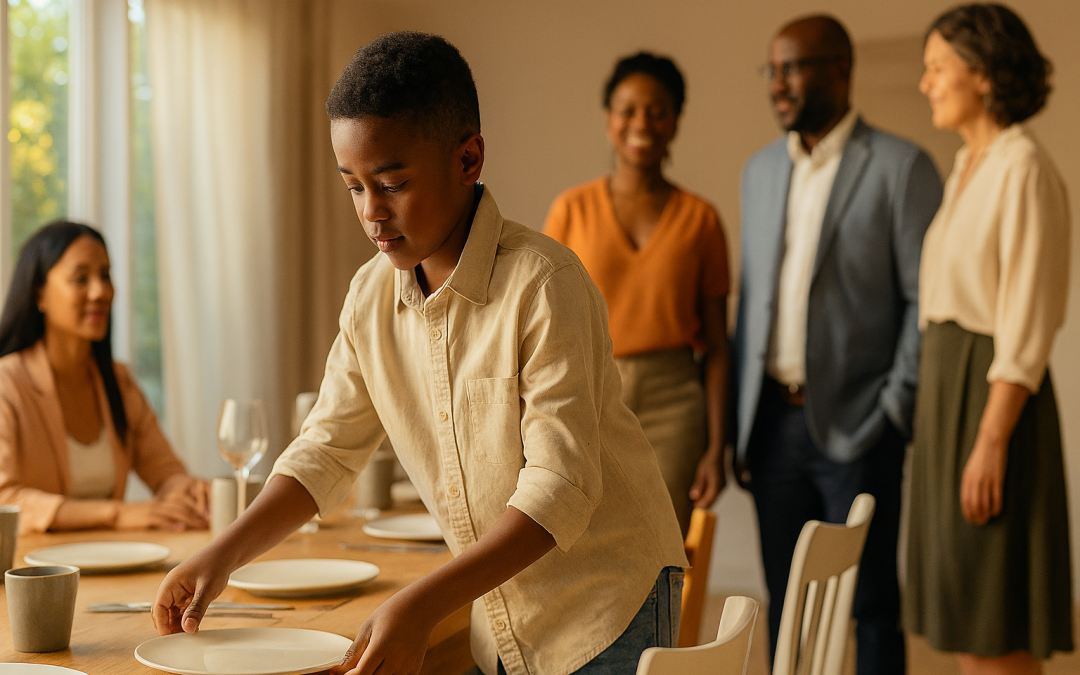
Collaboration begins at home.
When your child helps set the table, shares a toy with a sibling, or the two of them sort out a small fight together.
They are practising something much bigger than it seems: they are learning collaboration.
It may sound simple, but in a hyperconnected world full of global challenges, from climate change to artificial intelligence, collaboration is not just a soft skill.
Collaboration is one of the most valuable competencies a child can develop for their personal and professional future.
What if, instead of waiting for them to learn to collaborate when they reach work or university, children started living it from early on, at home and at school?
Why collaboration matters in the 21st century
No major problem is solved by one person alone today.
Vaccines, technological breakthroughs, and sustainability advances come from diverse teams working together.
At a smaller scale, collaboration drives any achievement that transcends the individual.
For children, collaborating means learning to listen, to take another’s perspective, to find solutions as a team, and to recognise that other people’s ideas also have value.
It is not only an academic issue: it is a life skill.
“Alone we can do so little; together we can do so much.” — Helen Keller
What does the evidence say about collaboration
Evidence says that collaboration prepares children emotionally and academically.
Teaching collaboration is not a passing pedagogical trend.
Research shows that developing this skill early yields lasting positive effects.
Children who feel part of a collaborative group experience less stress and greater satisfaction with school.
Collaboration in schools reduces social exclusion and improves student well-being.
Students who engage in collaborative projects from primary school develop stronger communication, resilience, and problem-solving skills than those who work alone.
These benefits persist into adolescence, increasing self-confidence and social relationships.
Collaboration also directly affects employability
It is among the most demanded skills in the modern labour market.
Success will depend less on competing against everyone and more on working with others to build solutions.
At NovaQuest Academy, collaboration is not an accidental outcome: it is a daily practice intentionally embedded in a pedagogy that places care and shared responsibility at the centre.
We see it in small gestures that mean a lot.
When a student hasn’t joined class, classmates reach out to invite them in.
When a child lacks materials during an experiment, peers narrate steps so everyone can participate.
In collective story-writing, each student contributes an idea until the story becomes a shared project.
These moments are not isolated anecdotes.
They are proof of what happens when education becomes communal rather than individualistic.
NovaQuest fosters empathy, respect, and solidarity by placing students in contexts where learning also means caring for others.
“Collaboration allows us to know more than we are capable of knowing by ourselves.” — Paul Solarz
How we teach collaboration in a virtual bilingual school
Collaboration depends on learning design, not on a physical room.
At NovaQuest Academy, our projects and activities are designed for students to work together across cities and time zones.
Typical practices include:
- Bilingual interdisciplinary projects such as Creativity Fairs and STEAM showcases.
- Interest clubs where students of different ages share passions like coding, writing, and art.
- Regular feedback dynamics where students give and receive constructive critique to improve joint work.
Constant practice of active listening and respectful communication strengthens teamwork inside and outside academic tasks.
STARTUP Pedagogy: turning collaboration into purposeful action
NovaQuest weaves STARTUP pedagogy into collaborative learning so projects become real, iterative, and socially meaningful:
- Situate real-world problems that require teamwork.
- Transversal learning across subjects, so solutions need multiple kinds of knowledge.
- Active experimentation and prototyping in teams.
- Reflection cycles where groups evaluate what worked and what to improve.
- Technologies that enable co-creation at a distance.
- Utility-driven projects that connect students with community needs;
- The progression of autonomy allows teams to take on increasing responsibility.
“Teach students to build, test, fail, learn, and iterate together; those cycles are the engine of lifelong collaboration.” John Hattie
Collaboration for life and work
Collaboration does not stop when a notebook closes or a camera turns off. It is a lifelong competence that will be central in interdisciplinary, global careers.
Children will need deep knowledge in their fields and the ability to work with people from different cultures, languages, and schedules.
The capacity to collaborate remotely, resolve conflicts, and add value to a team will be as important as academic qualifications.
Strengthens self-esteem by showing children that their ideas matter, trains active listening, and builds adaptability to face change with confidence.
Collaboration opens doors
It is not an educational extra; it is one of the most powerful competencies we can give our children.
It helps them grow as people, integrate into diverse teams, and prepare for a future where success depends less on winning and more on building together.
At NovaQuest Academy, we have seen collaboration transform students: they learn to trust classmates, listen with respect, contribute ideas, and solve real problems as a team.
That brings confidence, empathy, and creativity, qualities no standardised test can measure.
“Coming together is a beginning; keeping together is progress; working together is success.” — Henry Ford.
Thanks for reading. NovaQuest Academy launches in September 2026.
Join our community of parents who want to raise financially fluent, emotionally intelligent, and future-ready children.

Diana Pineda is an entrepreneur, educator, and author passionate about reimagining education for the next generation. She is the founder of Rhema E-School and NovaQuest Academy. She holds an MBA in Marketing from the University of Greenwich, England. She is a graduate of Universidad Externado de Colombia with a degree in Finance and International Relations and a specialist in Pedagogy and Didactics from Universidad de Medellín.