
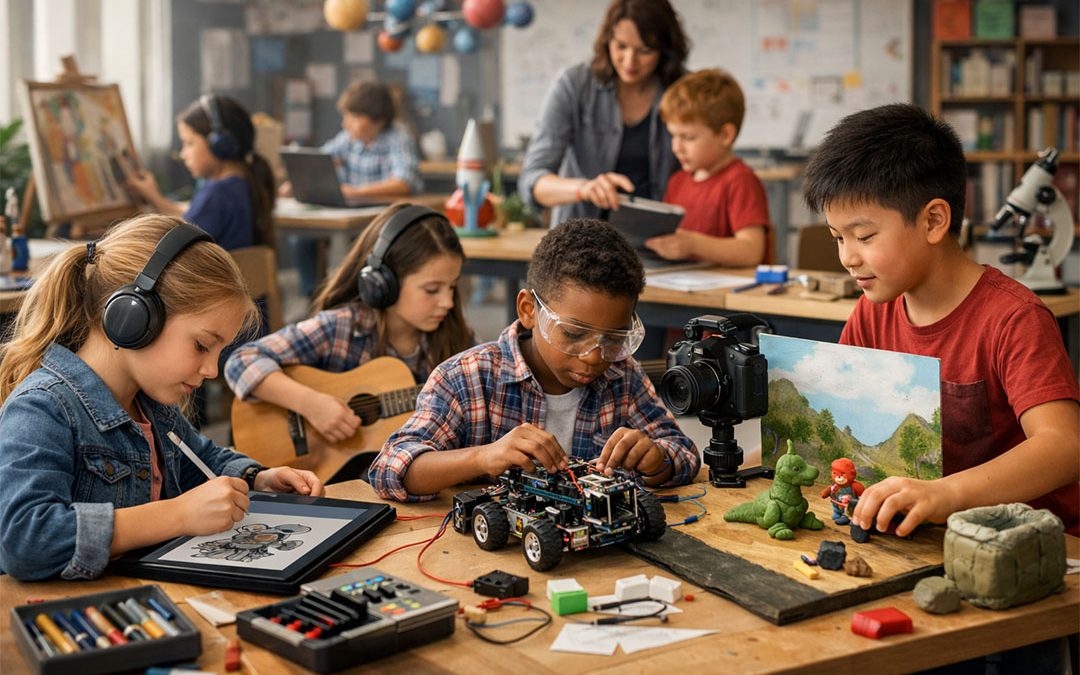
Walk into most primary schools in England, and you will find the same hierarchy.
Maths and English sit at the top.
The arts and practical subjects are squeezed into the margins.
And children are prepared, above all else, to pass tests.
But what about the child who thinks in pictures?
The one who builds things, writes stories, codes games, or loses track of time the moment music starts?
What is a standardised curriculum actually doing for them?
At NovaQuest Academy, we believe the answer to that question matters enormously.
We are building a new kind of online primary school, opening in September, founded on a simple principle: children learn better when education is built around who they already are.
Here are five reasons why talent-led learning works, and why it matters more than ever right now.
1. Children who learn through their talents are happier
Sir Ken Robinson, the late Liverpool-born educationalist whose 2006 TED Talk became the most-watched in history, told the story of Gillian Lynne.
As a child in the 1930s, Gillian’s teacher told her mother she had a learning difficulty.
She could not sit still.
She could not concentrate.
A doctor observed her privately, left the music playing in the room, and watched her immediately begin dancing.
His conclusion was straightforward: she was not ill.
She was a dancer.
Gillian Lynne went on to choreograph Cats and The Phantom of the Opera, two of the longest-running musicals in Broadway history.
She worked with the Royal Ballet for decades and became a multimillionaire.
She started formal dance training at 16, an age at which most would say the window had closed.
Robinson’s point was a painful one.
In today’s school system, Gillian would most likely have been medicated and kept quiet.
“Many highly talented, brilliant, creative people think they are not, because the thing they were good at at school was not valued, or was actually stigmatised.”
Sir Ken Robinson, The Element (2009)
At NovaQuest, we expose children to a broad range of disciplines, including art, technology, coding, entrepreneurship, animation, and creative writing, precisely so they can find what ignites them.
When a child is working within their element, learning stops feeling like effort.
Curiosity takes over.
That shift changes everything.
2. Practice within a talent produces real mastery
Talent is a starting point, not a destination.
It needs conditions to grow.
Robinson put it plainly: “Human resources are like natural resources; they are often buried deep.
You have to go looking for them.”
Sir Ken Robinson
In a traditional school, the curriculum moves on regardless of whether a child has found their footing.
There is rarely time to go deep.
3 hubs plus mindfulness
At NovaQuest, we rotate children through dedicated learning hubs that each term cover technology, the arts, and entrepreneurship.
Within those hubs, children do not just learn about subjects; they make things.
They produce animations, build apps, pitch ideas, and publish work.
One of our students from our sister school in Latin America, Alicia, had always loved to draw.
Given time and structured guidance in animation, she produced a short animated film: 127 hand-drawn frames, complete with a script, voice-over, editing, and publication.
That is not a school exercise.
That is mastery in progress.
The evidence supports this approach.
Research published by Michigan State University found that having a persistent, intellectually challenging hobby, such as musical performance, visual art, or coding, is a stronger predictor of career success than grades, test scores, or IQ.
3. Talent-led learning preserves and builds creativity
Children arrive at school creative.
Most leave less so.
Robinson described it with characteristic directness:
“We don’t grow into creativity, we grow out of it. Or rather, we get educated out of it.”
Sir Ken Robinson
When every subject has one correct answer, and every mistake is marked in red, children quickly learn that originality is a risk not worth taking.
By the time they reach secondary school, many have already stopped trying.
School teach children out of creativity
The UK government’s own curriculum review, launched in 2024 under Professor Becky Francis, acknowledged this directly.
The English Baccalaureate, which has driven school performance measures for over a decade, has been blamed for squeezing the arts out of state schools.
The review’s response included plans to scrap the EBacc measure and to create a new enrichment entitlement, ensuring that children have access to creative and character-building experiences.
It is significant that these reforms are now being called for.
But they apply to state schools from 2028 at the earliest.
At NovaQuest, this is how we work from day one.
Consider Santiago, another student from our sister school.
He had never made a video before he began working in our arts-and-technology sessions.
Within weeks, he was disappearing for hours at a time, emerging with stop-motion animations made from clay figures he had designed and built himself.
He later created a video game with a classmate, launched his own brand, and began selling his work online.
He was eleven years old.
Creativity is not a personality trait.
It is a skill that grows when children are given the space, materials, and permission to make things that matter to them.
4. Children who discover their talents build genuine confidence
Traditional schooling is structured by age.
You enter Reception and move up one year at a time, regardless of where you actually are.
The message this sends, intentionally or not, is that all children are the same and that those who fall outside the norm are behind.
At NovaQuest, we do not use year groups in the traditional sense.
Children are grouped by readiness and ability within each subject, not by age.
A child can be working at an advanced level in coding while still developing in written English, and that is not a deficit.
That is how people actually work.
When a child discovers something they are genuinely good at, the effect on their self-perception is immediate.
They become more willing to take risks in other areas.
They develop a sense of identity that is not dependent on a test result.
They start to understand themselves as capable people, not just students.
One of our students
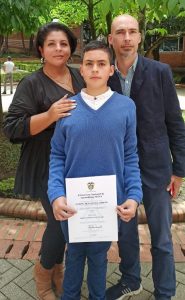
Samuel, a student at our sister school in Colombia, entered his technology class wanting to become an architect.
During a coding session, his entire direction changed.
He started researching university programmes, cold-calling institutions, and preparing a formal application.
At 13, he was accepted into a technology degree programme, the youngest person in the university’s history to do so.
He graduated at 16.
What changed was not his intelligence.
What changed was that he was given access to something that matched who he was.
5. Breadth of experience produces innovation
There is a persistent assumption that the path to success is narrow specialisation.
Focus on one thing. Excel at it.
Everything else is a distraction.
The evidence tells a different story entirely.
A landmark study by researchers at Michigan State University, drawing on data from 773 Nobel laureates between 1901 and 2008, found that Nobel Prize-winning scientists are approximately nine times more likely than the average scientist to have formal training in crafts or fine arts.
Nobel Prize winners in literature are roughly 20 times more likely than the general public to have worked as actors.
The researchers concluded that creative polymathy, the deliberate integration of skills from multiple disciplines, is not a distraction from excellence.
It is a precondition for it.
“The answer is not to standardise education, but to personalise and customise it to the needs of each child and community.
There is no alternative.
There never was.”
Sir Ken Robinson, The Element (2009)
NovaQuest is built around this understanding.
Children are creative and academic
We do not ask children to choose between being creative and being academic.
We teach them that the two reinforce each other.
A child who learns to animate a story is also learning sequencing, narrative structure, and persistence.
A child who builds a business plan for a school fair is learning maths, communication, and self-advocacy.
The National Skills Imperative 2035, published by the National Foundation for Educational Research, identified the six skills most likely to be in demand across the labour market by 2035:
- Communication
- Collaboration
- Problem-solving
- Organising and prioritising
- Creative thinking and
- Information literacy.
Not one of these is best developed by sitting quietly and memorising facts for an end-of-year examination.
What this means for your child
The UK curriculum is changing.
The government has acknowledged that children need more than academic knowledge to thrive.
But state-sector reform takes time.
The new curriculum will not be fully implemented until 2028.
NovaQuest Academy is not waiting.
We open in September, and we are accepting admissions until 31st July.
We are an independent online primary school designed for families who want something different: a rigorous, creative, talent-led education that prepares children for a world that values curiosity, adaptability, and original thinking.
If that sounds like what your child needs, we would love to hear from you.
Frequently Asked Questions
What is an alternative school?
An alternative school centres learning on projects, interests, and individual strengths rather than on memorisation for examinations.
Children explore a broader curriculum, including arts, technology, and entrepreneurship, alongside core academic subjects.
How does NovaQuest identify a child’s talents?
Through rotating learning hubs in art, technology, and entrepreneurship, combined with project-based work across all subjects.
Children are given the time and materials to explore, and their strengths become visible through what they make and how they engage.
Can an online school really be an alternative?
Yes.
NovaQuest is fully online and fully project-based.
Children work with teachers and peers in live sessions, produce real work for real audiences, and develop skills that transfer far beyond the school day.
The medium is virtual.
The learning is very real.
Is NovaQuest accredited?
NovaQuest Academy is an independent school for primary-aged children. It’s registered in the House of Companies. Company Number: 16894661
Please contact us for details on accreditation, curriculum alignment, and our support for progression to secondary education.
Sources
Robinson, K. (2009). The Element: How Finding Your Passion Changes Everything. Penguin.
Root-Bernstein, R. et al. (2008). Arts Foster Scientific Success. Journal of Psychology of Science and Technology, 1(2).
Root-Bernstein, R. & Root-Bernstein, M. (2022). Nobel Prizes Most Often Go to Researchers Who Defy Specialisation. The Conversation.
National Foundation for Educational Research (2023). Skills Imperative 2035.
Department for Education (2025). Curriculum and Assessment Review: Government Response.
Times Education Commission (2022). Ending the Big Squeeze on Skills. Tony Blair Institute for Global Change.
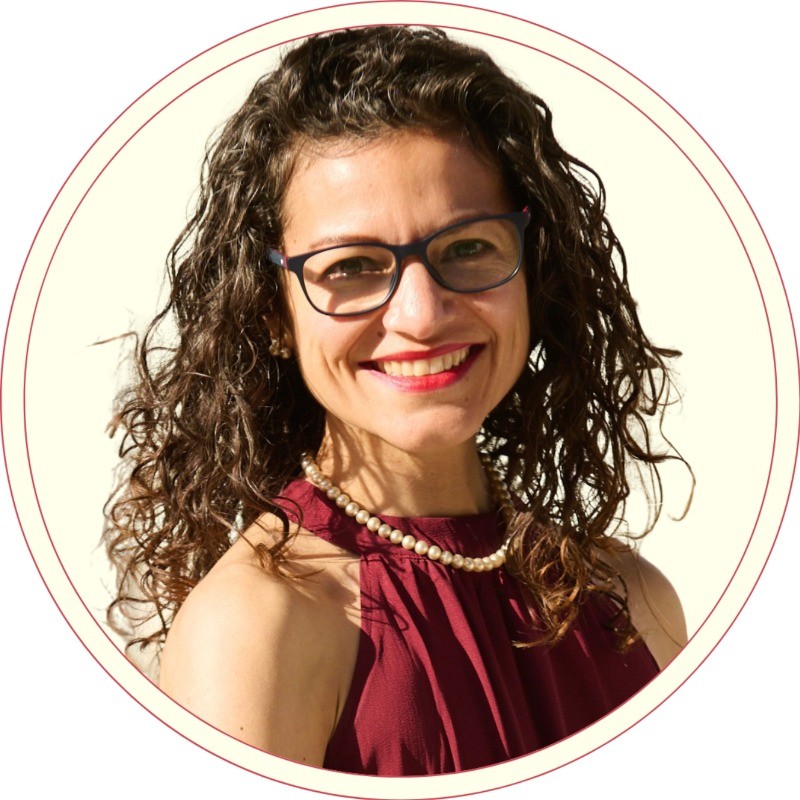
Diana Pineda is an entrepreneur, educator, and author passionate about reimagining education for the next generation. She is the founder of Rhema E-School and NovaQuest Academy. She holds an MBA in Marketing from the University of Greenwich, England. She is a graduate of Universidad Externado de Colombia with a degree in Finance and International Relations and a specialist in Pedagogy and Didactics from Universidad de Medellín.