
A Parent’s Guide to Growing Self-Aware, Emotionally Strong Children
Children today grow up in a noisy world.
Notifications, constant comparison, academic pressure, and very little time to pause and think.
Schools teach literacy and maths, but rarely teach kids how to understand themselves.
Parents feel this gap every day.
This guide walks through why mindfulness matters from early childhood through adolescence.
What it looks like beyond meditation, what the research actually says, and how parents can start building these skills at home.
It also shows how online learning changes the experience and why this matters for the future of education and work.
What Do We Mean by Mindfulness for Children? (Not Just Meditation)
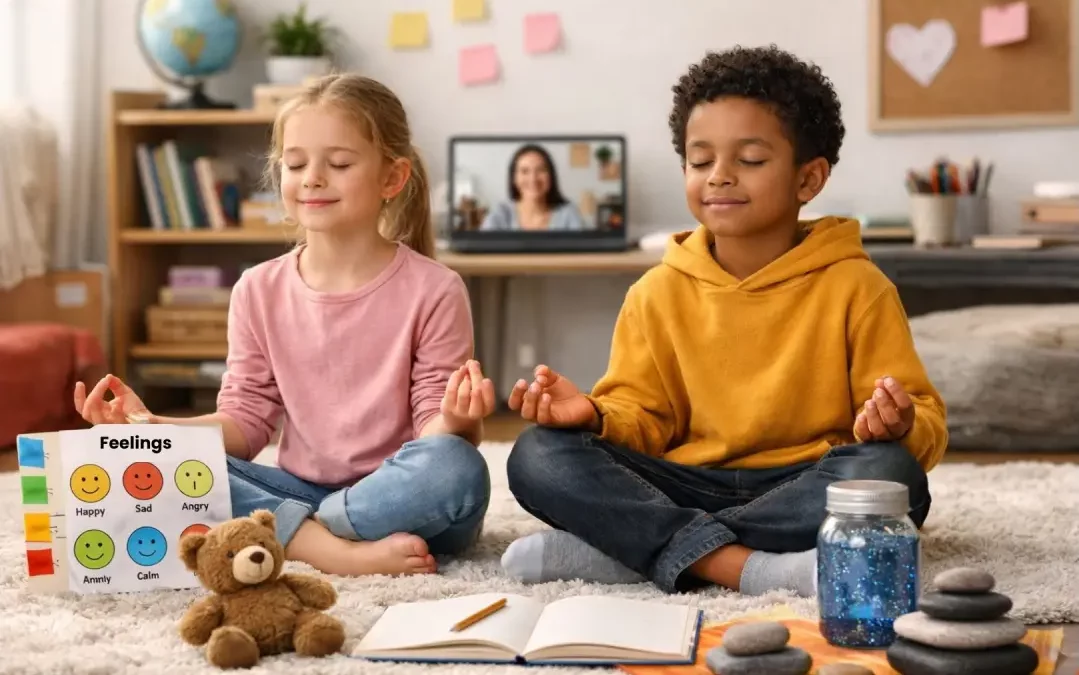
Mindfulness for children often appears in articles featuring kids sitting cross-legged with eyes closed.
Real mindfulness is broader and more useful.
A widely cited definition comes from Jon Kabat-Zinn: paying attention to the present moment on purpose and without judgment.
Researchers also link mindfulness to self-awareness, emotion regulation, and cognitive flexibility.
For children, mindfulness includes:
- Knowing how they feel
- Naming emotions (sad, happy, hopeless)
- Noticing body signals (tension, excitement, overwhelm)
- Understanding what triggers them
- Noticing thoughts without being swallowed by them
- Dealing with setbacks
- Making space between stimulus and reaction
Mindfulness for children touches five major domains:
- Attention
- Emotion awareness
- Interoception (body awareness)
- Self-reflection
- Social awareness
Meditation is one tool. Not the whole toolbox.
Why Mindfulness in Childhood Matters
People tend to ask: “Isn’t mindfulness for stressed adults?”
A better question is: “What if kids learned these tools before adulthood?”
Research suggests childhood and early adolescence are critical windows for developing executive function. Working memory, inhibitory control, and cognitive flexibility.
These skills predict academic performance, peer relationships, and mental health more than IQ.
Mindfulness in children maps to these skill sets in simple ways:
- Noticing feelings → emotion regulation
- Pausing before reacting → inhibitory control
- Observing thoughts → metacognition
- Understanding others → empathy
- Naming needs → communication
Parents see the gaps at home: frustration, meltdowns, comparison anxiety, perfectionism, avoidance, sibling conflict, and withdrawal.
Schools rarely address these directly because curricula were designed for industrial obedience rather than self-knowledge or emotional agency.
Mindfulness in Full-Time Education vs the Reality of School
Full-time traditional schooling has constraints:
- Crowded classrooms
- Tight schedules
- Compliance-based routines
- Limited emotional check-ins
- Low adult-to-student emotional bandwidth
Many schools focus on behaviour management rather than self-management.
A calm classroom is not the same as an emotionally literate classroom.
Parents sometimes assume mindfulness means “kids sitting quietly so teachers can teach.”
That’s behaviour, not self-awareness.
Mindfulness should help kids:
- Notice when they’re overwhelmed
- Ask for space
- Repair social ruptures
- Understand preferences and values
- Process change
- Make decisions with agency.
These are long-term human competencies, not classroom hacks.
Mindfulness in Online Schooling
Online learning changes the dynamics, sometimes for the better.
Advantages of Mindfulness for Children Studying Online
- Kids get space for reflection
- Fewer sensory overload triggers (noise, crowding)
- Asynchronous thinking time
- Home environment feels safer for emotional honesty
- Parents can observe social-emotional growth.
Parents often see more of their child’s inner world when learning happens at home.
This opens space for conversations that never happen in a physical school corridor.
Online education can integrate:
- Camera-off reflection time
- Journaling
- Emotion check-ins in chat
- Breakout dialogues
- One-on-one coaching
- Paced processing instead of real-time social pressure.
Students with anxiety, ADHD, or sensory sensitivities often report feeling more in control online.
That control is a foundation for emotional regulation.
Challenges Online
We should be honest:
- Fewer spontaneous peer conflicts to practice resolution
- Risk of social isolation if not designed well
- Screens can drain attention if not structured thoughtfully.
These challenges can be addressed through community design, group projects, mixed online/offline tasks, and parent partnerships.
NovaQuest builds this into pedagogy rather than treating it as an afterthought.
We have quarterly in-person meetings, and in the future, we will have one day of in-person meetings per week.
Homeschool families already improvise these social layers.
Clubs, co-ops, sports, maker groups, youth groups.
Online schools can support parents in planning this ecosystem rather than pretending that school is the only social arena.
Age Stages: How Mindfulness Develops Over Time
Children don’t become self-aware at once. It unfolds.
Early Primary Students (Ages 4–7)
Kids learn:
- Emotional vocabulary (“sad”, “worried”, “frustrated”, “excited”)
- Basic body awareness
- Waiting for their turn
- Noticing when someone else is upset
Executive function is still forming.
Mindfulness here looks playful and sensory.
Useful practices:
- Breathing with stuffed animals
- Naming feelings through colours
- Mirroring faces in the mirror
- The “story of my day” sharing at dinner.
Research suggests that early social-emotional instruction reduces aggression, increases positive peer interactions, and improves attention.
Late Primary Students (Ages 8–12)
Kids develop:
- Social comparison
- Competence beliefs
- Identity seeds
- Complex emotions (shame, disappointment, pride)
- First real conflicts.
Mindfulness here involves:
- Journaling about triggers
- Noticing self-talk
- Practising communication scripts
- Simple conflict resolution steps.
Evidence shows that mindfulness training over the past few years has improved working memory and emotional regulation.
Secondary Students (Ages 12–17)
Adolescence is intense.
Hormones are not the whole story; the limbic system matures faster than the prefrontal cortex, creating emotional volatility.
Mindfulness helps teens:
- Spot cognitive distortions (“nobody likes me,” “I always fail”)
- Regulate rumination (linked to depression/anxiety)
- Manage identity experimentation
- Deal with school pressure and social drama
- Make more thoughtful decisions.
School-based mindfulness research with teens suggests reductions in stress and rumination and improvements in mood.
This is also when entrepreneurial traits begin revealing themselves: agency, risk-taking, curiosity, feedback processing, and resilience after failure.
Future Economy Skills: Why Mindfulness in Children Matters Beyond Wellbeing
Parents want their kids to feel good.
Parents also want their kids to function in the world.
Mindfulness supports both.
Mindfulness is foundational for:
- Leadership
- Collaboration
- Conflict navigation
- Self-directed learning
- Creative work
- Decision-making under pressure.
These skills are now visible in entrepreneurship research, founder psychology, and tech leadership studies.
Emotional intelligence predicts leadership effectiveness more strongly than IQ.
Kids who learn emotional agency early:
- Build stronger friendships
- Adapt faster
- Communicate more clearly
- Handle setbacks without collapsing
- Make career choices that suit them.
This matters for employment, freelancing, entrepreneurship, and all future-work models, not just “mental health.”
Homeschool parents already notice this link; kids who know themselves learn better, communicate better, and take creative risks.
Mindfulness Components (Beyond “Sit Still and Breathe”)
The full toolkit includes:
- Interoception: Noticing body signals (tension, hunger, butterflies).
- Emotion Literacy: Naming feelings precisely, not just “fine.”
- Attention Training: Single-tasking, patient listening, staying with tasks.
- Self-Reflection: Asking “Why did I react like that?”
- Perspective-Taking: Seeing others’ feelings and motives.
- Boundaries & Social Navigation: Handling difficult people without losing oneself.
- Values & Identity: Knowing what matters and what doesn’t.
Entrepreneurs, scientists, engineers, and artists all rely on these.
Mindfulness at Home: Practical Activities for Parents
Parents don’t need formal training.
Small habits matter more than perfect scripts.
Primary Students (Ages 5–11)
Activities:
- Emotion Wheel Check-Ins: point to how you feel before dinner.
- Sensory Walk: “name 3 sounds, 2 colours, 1 smell.”
- Tummy Breathing with Toy: watch it rise/fall.
- Story Journals: one sentence + picture about their day.
- Freeze & Notice Game: pause mid-play and ask what they hear.
- Feelings Charades: act out emotions, guess together.
At this age, mindfulness is still embodied and playful.
Secondary Students (Ages 12–17)
Activities:
- Trigger Journaling: “When X happened, I felt Y because…”
- Values Mapping: list 10 values, circle the top 3.
- Breathing Variations: box breathing, 4-7-8, paced breathing.
- Thought Distortion Check: spot “always,” “never,” “everyone.”
- Conversation Labs: listen without fixing the problem.
- Media Diet Reflection: notice mood after social media.
Parents can model honesty here: “I got annoyed at work, and I’m taking a pause.”
All these exercises need your input as a parent.
Borrow your full attention to them.
Dealing with Difficult People (Including Siblings & Parents)
Mindfulness must not pretend relationships are easy.
Kids deal with:
- Sibling rivalry
- Strict teachers
- Overwhelmed parents
- Friend drama.
Useful tools:
- Boundaries (“I don’t like when you… please stop.”)
- Rupture & Repair (conflict → repair → move on)
- Emotional Signals (clenched fists = pause moment)
- Reframing (“maybe they’re having a bad day”)
- Walking Away (self-protection is valid)
Parents can admit fault.
Kids learn repair by watching repair.
Evidence-Based Benefits (Without Magical Thinking)
Research on child mindfulness and SEL (Social and Emotional Learning) programs reports:
- Improved executive function
- Lower aggression
- Increased prosocial behaviour
- Reduced rumination and stress
- Better self-regulation and reduced anxiety
- Increased academic persistence
Not every study shows huge effects.
Sample sizes vary.
Implementation matters.
Kids differ.
Claims that mindfulness “fixes everything” are unrealistic.
Still, the evidence is strong enough that many mental health organisations and schools consider SEL essential rather than optional.
The OECD forecasts that emotional regulation and metacognition will be key future skills.
This aligns with real workplace data from HR and leadership studies.
FAQ (Mindfulness for Children)
Is mindfulness religious?
No. Contemporary child mindfulness is secular and behavioural. It focuses on attention and emotion skills.
Will mindfulness calm my child?
Sometimes. The goal is awareness, not forced calm. Calm is a byproduct of regulation, not compliance.
What if my child hates meditation?
Plenty of alternatives exist: journaling, drawing, movement, sensory work, music, and nature walks.
How does this help with academics?
Self-regulation improves task initiation, attention, and persistence, all of which are linked to school performance.
Is online mindfulness worse than in-person?
Different, not worse. Online models often allow more reflection time, less overstimulation, and stronger parent partnership.
What about homeschoolers?
Homeschool environments are ideal for mindfulness because they allow personal pace, family dialogue, mixed-age socialisation, and identity-driven projects.
Final Thought
The question isn’t whether kids can learn mindfulness.
The real question is what happens if they never do.
Adults who never learn these tools struggle silently for decades.
Kids who learn them early build lives that fit who they are, not who they were told to be.
Mindfulness is foundational to humanity and to the future of work.
NovaQuest treats it that way.
Do you want to try us before committing to a year?

Diana Pineda is an entrepreneur, educator, and author passionate about reimagining education for the next generation. She is the founder of Rhema E-School and NovaQuest Academy. She holds an MBA in Marketing from the University of Greenwich, England. She is a graduate of Universidad Externado de Colombia with a degree in Finance and International Relations and a specialist in Pedagogy and Didactics from Universidad de Medellín.