
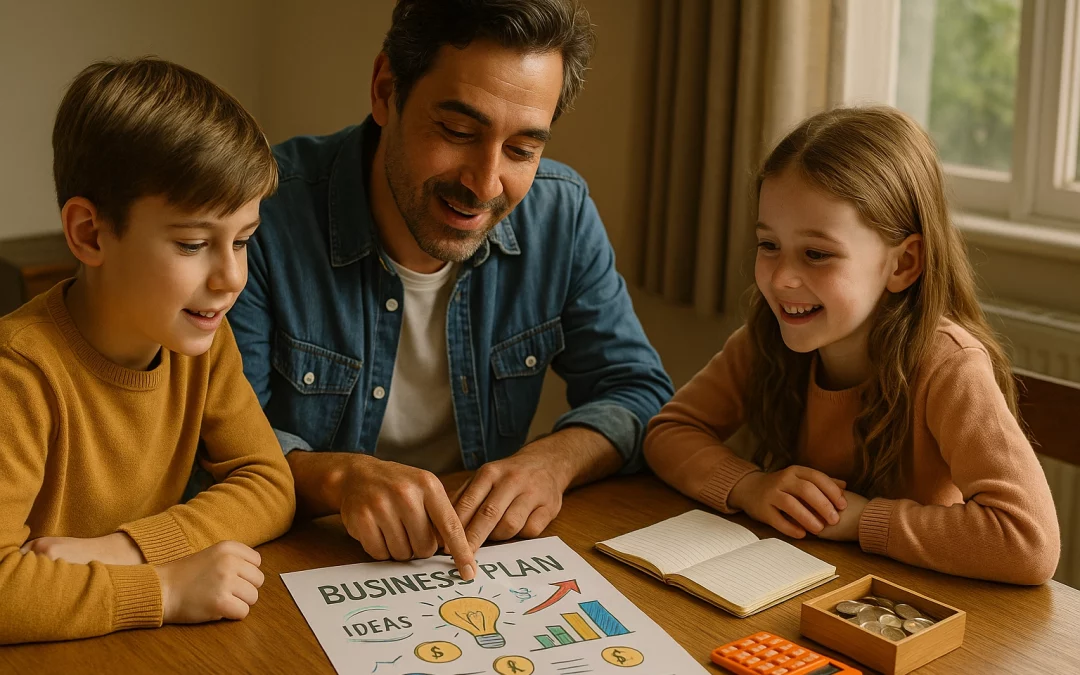
When you think about your child’s future, you probably picture them doing well at school, finding a career they enjoy, and feeling confident in who they are.
What often gets overlooked is that the skills that shape that future can be learned much earlier, in ways that feel more like play than work.
That’s where entrepreneurship education comes in.
Entrepreneurship at a school age is about giving children opportunities to solve problems, try out ideas, and discover how creativity can turn into something real.
Whether they’re in primary school or heading into their GCSE years, children who experiment with small business projects, like designing a craft to sell at a school fair or running a mini-company with classmates, develop life skills that textbooks alone rarely provide.
Around the world, education experts and governments are recognising the value of this approach.
In the UK, charities like Young Enterprise have been introducing pupils to hands-on business projects for decades, and reports recommend starting as early as primary school.
Studies from Europe, Asia, and beyond show that young people who engage in entrepreneurship education become more adaptable, confident, and resilient as they grow.
For you as a parent, the question isn’t whether your child will run a company one day, but how equipping them with an entrepreneurial mindset now can make them better prepared for whatever future they choose.
Cognitive Benefits of Teaching Entrepreneurship to Kids: Business Know-How & Financial Literacy
When children try out entrepreneurship, even on a small scale, they begin to understand how the world of business works.
A simple project like selling homemade crafts at a school fair introduces the basics: generating ideas, planning, setting prices, and serving customers.
Programmes such as BizWorld, which has been tested in Europe and North America, show how 11- and 12-year-olds can grasp business fundamentals through playful simulations.
Researchers found that participants developed a clearer picture of how companies operate and felt more capable of turning ideas into action.
These experiences also connect directly to financial literacy, an area many parents worry is neglected in traditional schooling.
Children learn to budget pocket-sized projects, compare costs with earnings, and decide how to reinvest or save their profits.
The UK’s Fiver Challenge works exactly this way: primary students receive £5 and a month to “grow” it.
They quickly realise that money is a tool, not just something to spend.
Studies consistently show that young people who encounter financial education early make better decisions later.
For example, a study published in the Journal of Economic Literature found that teenagers exposed to finance-related learning had stronger money management habits and were less likely to fall into debt as young adults.
These lessons don’t have to stop at school. At home, you can encourage your child to run small “ventures” of their own:
- Pocket money projects: challenge them to double their allowance by making and selling something simple, like bracelets or cookies.
- Chores-for-pay systems: let them set their own “price list” for extra household tasks, then track their earnings and savings.
- Neighbourhood services: older children can offer dog-walking, car washing, or tutoring. They’ll quickly learn how to calculate time, effort, and fair pricing.
Entrepreneurship projects also link classroom knowledge with real-world application.
Maths suddenly matters when a group has to calculate costs and revenue.
Writing skills shine in crafting a sales pitch.
Teamwork and negotiation become vital in running a project.
Evaluations of the UK’s Young Enterprise Company Programme highlight this crossover effect: students reported not only improved business understanding but also stronger problem-solving and adaptability skills.
For you as a parent, the value is clear.
Entrepreneurship offers your child a safe, structured way to practise business thinking and financial responsibility long before they face those challenges in adult life.
It turns abstract concepts into lived experience, giving them confidence with money and decision-making that will benefit them well beyond school.
Non-Cognitive Benefits of Teaching Entrepreneurship to Kids: Confidence, Creativity, and Resilience
The biggest gains for children learning entrepreneurship often come in the form of “softer” skills: the personal qualities that help them thrive in school, friendships, and eventually, work.
Confidence and self-belief
When children take part in an entrepreneurial project, they see first-hand that their ideas matter.
A shy student who presents a product at a school fair often walks away taller, knowing they can speak up and be heard.
Research on youth enterprise programmes has repeatedly shown increases in self-efficacy, that is, a child’s belief in their ability to reach goals.
For example, a UK study of the Young Enterprise Company Programme found that teenagers reported significantly higher self-esteem and confidence after running a business for a year.
Even short activities make a difference: a field experiment in the Netherlands found that after a five-day entrepreneurship programme, 11–12 year olds had measurably greater belief in their own abilities.
Creativity and problem-solving
Children are naturally inventive and creative.
Entrepreneurship gives them a canvas to test their imagination.
Whether it’s designing a new snack or finding a clever way to attract customers, they learn to connect ideas in original ways.
Studies highlight that young people who participate in enterprise education improve their opportunity recognition and creative thinking skills.
In practice, this looks like a child suggesting, “What if we sell our cookies in bundles instead of singles?” or drawing up a colourful poster to stand out from the competition.
These small sparks of creativity reinforce the idea that solutions don’t have to be handed down from adults, kids can generate them, too.
Resilience and adaptability
Not every idea works, and that’s the point.
When a product doesn’t sell or a team struggles to agree, children experience setbacks in a safe environment where the stakes are low.
Instead of discouraging them, these moments teach persistence.
Long-term studies show that alumni of entrepreneurship programmes feel better prepared to cope with life’s challenges and changes.
Parents often see this resilience at home.
A child who once gave up quickly might now adjust, try a different approach, and keep going.
These early lessons in bouncing back become building blocks for a growth mindset, a belief that effort and persistence matter more than getting it perfect the first time.
Teamwork and leadership
Many entrepreneurship projects require children to work in groups.
Roles such as “finance manager” or “marketing lead” may sound playful, but they help children practise collaboration and leadership.
A review of European programmes found that teamwork and communication consistently improved among participants.
For some children, this might mean learning to listen better; for others, it’s the first taste of leading a group towards a shared goal.
For you as a parent, these benefits are invaluable.
Confidence, creativity, resilience, and teamwork aren’t just skills for business. They’re life skills.
They help your child tackle exams, navigate friendships, and eventually adapt to an unpredictable job market.
Entrepreneurship offers a practical, engaging way to nurture them early on.
What You Might Be Wondering as a Parent About Teaching Entrepreneurship to Kids
It’s natural to have questions about introducing entrepreneurship at a young age.
Here are a few common concerns and what research and experience suggest in response.
“What if my child is too young for this?”
Children don’t need to be teenagers to start learning entrepreneurial skills.
At younger ages, the emphasis is on playful, age-appropriate activities like designing a simple product, running a stall at a school fair, or managing a small project with friends.
Education researchers note that the benefits of entrepreneurship education are greater when it begins in primary school and continues through later years (European Commission, 2015).
Early exposure builds curiosity, creativity, and confidence in ways that textbooks alone can’t.
“What if my child is overly focused on money?”
Most school and community programmes highlight creativity, teamwork, and responsibility before profit.
Many projects donate proceeds to charity or tackle social issues, introducing children to the idea of social entrepreneurship.
Research shows that non-financial benefits, such as problem-solving, resilience, and leadership, are what stick with children the most.
Money is simply the tool they use to learn those lessons, not the end goal.
“What if failure discourages them?”
Setbacks are an expected part of the process. In fact, that’s where much of the learning happens.
A group that struggles to sell all its cupcakes will quickly brainstorm new approaches, perhaps adjusting prices or improving marketing.
Studies show that alumni of enterprise programmes feel more able to cope with challenges and change later in life.
In this context, failure is practice in resilience and adaptability.
“How does this connect to schoolwork?”
Entrepreneurial activities bring classroom learning to life.
Maths becomes budgeting, writing turns into persuasive marketing, and science can inspire product design.
UK evaluations of enterprise programmes highlight that students not only gain business knowledge but also strengthen critical thinking and adaptability, which directly support academic achievement.
For many children, it’s the moment when they realise subjects aren’t just for exams, but have real-world value.
As a parent, your role is simply to encourage, support, and celebrate their small wins.
Whether your child runs a “company” for four weeks or designs posters for a charity bake sale, the outcome isn’t measured in pounds earned but in the skills and confidence they take forward.
Nurturing an Enterprising Generation
When you support your child in exploring entrepreneurship, you’re doing more than teaching them about money or business.
You’re helping them build qualities that last a lifetime: confidence to speak up, creativity to find solutions, resilience to bounce back, and the ability to work well with others.
These are the very skills that employers, universities, and communities value most, and they begin with small steps taken in childhood.
The research is clear: children who experience enterprise education are better prepared to handle challenges, adapt to change, and see opportunities where others see obstacles.
Whether your child becomes a teacher, engineer, artist, or entrepreneur, the mindset they gain will travel with them into every corner of their future.
For you as a parent, encouraging entrepreneurship doesn’t require grand gestures.
It might mean backing their idea to run a stall at the school fair, supporting a pocket-money project at home, or simply asking curious questions about how they’d solve everyday problems.
These moments add up, and they send a powerful message: your ideas matter, and you are capable of bringing them to life.
In the end, the real profit goes beyond pounds or products and comes down to the growth you witness as your child becomes more confident, creative, and ready for the world ahead.
Nurture an enterprising mindset today, to give them a gift that will serve them for years to come.
References
- Huber, L. R., Sloof, R., & Van Praag, M. (2014). The effect of early entrepreneurship education: Evidence from a randomized field experiment. European Economic Review, 72, 76–97.
- Young Enterprise (2018). Impact Report.
- Moberg, K., Vestergaard, L., Fayolle, A., Redford, D., Cooney, T., Singer, S., & Sailer, K. (2014). How to assess and evaluate the influence of entrepreneurship education: A report of the ASTEE project. Danish Foundation for Entrepreneurship.
- Johansen, V., & Schanke, T. (2013). Entrepreneurship education in secondary education and training. Scandinavian Journal of Educational Research, 57(4), 357–368.
- European Commission (2015). Entrepreneurship Education: A road to success.

Diana Pineda is an entrepreneur, educator, and author passionate about reimagining education for the next generation. She is the founder of Rhema E-School and NovaQuest Academy.