
Art and culture have always been central to human development.
Yet traditional education has gradually pushed the arts aside, focusing instead on preparing students for standardised exams.
Tests that rarely measure creativity, imagination, or emotional expression.
This creates a paradox.
Schools aim to prepare children for the future, but many of the skills most needed in the modern world are:
All these are developed most effectively through the arts.
In recent years, educators, researchers, and forward-thinking schools have begun restoring the arts to their rightful place in education.
The results are clear: students become more engaged, more confident, and more capable learners.
At NovaQuest Academy, the arts are not an optional extra.
They are a core pillar of learning.
Here are ten reasons why the arts are essential in education.
1. The Arts Increase Student Engagement
Art transforms students from passive listeners into active creators.
Instead of sitting still for hours, students use their hands, experiment with materials, and see immediate results from their effort.
They create tangible work, paintings, music, performances, and designs that reflect their thinking and imagination.
This process builds confidence.
Students begin to see themselves as capable creators, not just recipients of information.
That shift changes their relationship with learning itself.
Engaged students learn more deeply, remember more, and develop a stronger sense of purpose.
2. The Arts Develop Positive Habits and Character
Art teaches discipline in a natural, meaningful way.
Learning an instrument, mastering a dance sequence, or completing a complex artwork requires patience, persistence, and practice.
Students learn that improvement comes through effort, not instant success.
They develop habits that extend far beyond art:
- Persistence when facing challenges
- Patience during long learning processes
- Focus and attention to detail
- Pride in meaningful work
These habits form the foundation for success in every field, from science to entrepreneurship.
Schools that integrate the arts often report improved behaviour, stronger motivation, and more positive classroom environments.
3. The Arts Develop Creativity: the Most Important Skill of the Future
Creativity is now widely recognised as one of the most valuable skills in the modern economy.
The World Economic Forum consistently ranks creativity among the top skills needed for future jobs.
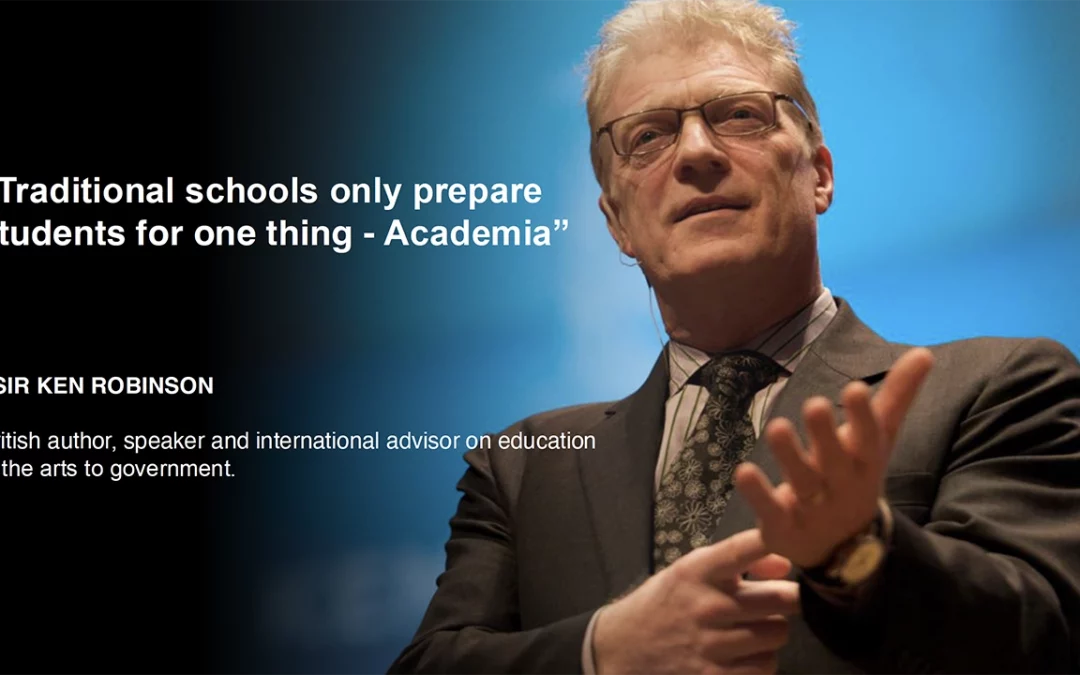
Sir Ken Robinson said it better:
“My contention is that creativity now is as important in education as literacy, and we should treat it with the same status”. We don’t grow into creativity, we grow out of it. Or rather, we get educated out of it”.
As automation and artificial intelligence take over routine tasks, human creativity becomes even more essential.
Art provides a structured environment for creativity to grow.
Students learn to:
- Generate original ideas
- Experiment without fear of failure
- Solve problems in multiple ways
- Express their unique perspective
These abilities prepare students for artistic careers and also for leadership, innovation, and entrepreneurship.
4. The Arts Strengthen Critical Thinking and Intellectual Skills
Art teaches students how to observe, interpret meaning, and analyse complex ideas.
When students study or create art, they learn to:
- Notice subtle details
- Understand symbolism
- Consider multiple perspectives
- Interpret emotion and intention
These skills translate directly into academic success and real-world decision-making.
In a world filled with misinformation, students need the ability to think critically, evaluate ideas, and form independent conclusions.
The arts train the mind to do exactly that.
5. The Arts Strengthen Language and Communication Skills
Art supports language development in powerful ways.
Students expand their vocabulary as they describe their work, discuss ideas, and interpret meaning.
Music develops sensitivity to rhythm and sound, which supports reading and language acquisition.
Drama improves verbal expression, confidence, and storytelling ability.
Students who participate in the arts often become stronger communicators, an essential skill in every profession.
6. The Arts Support Mathematical Thinking
Art and mathematics are deeply connected.
Students use mathematical thinking when they:
- Measure proportions in visual art
- Recognise patterns in music and dance
- Understand symmetry and geometry
- Work with rhythm, timing, and fractions
Research has shown that students involved in music education, in particular, often demonstrate stronger mathematical performance.
Art makes abstract mathematical concepts tangible and meaningful.
7. The Arts Enrich Learning Across All Subjects
Art connects naturally with every academic discipline.
- History becomes vivid through paintings, music, and cultural artefacts.
- Literature comes to life through theatre and storytelling.
- Science becomes clearer through drawing, modelling, and design.
- Technology becomes creative through digital art, animation, and media.
Many of the world’s greatest innovators, such as Leonardo da Vinci, Steve Jobs, and others, combined artistic thinking with scientific and technological knowledge.
Innovation lives at the intersection of disciplines.
8. The Arts Develop Emotional Intelligence and Empathy
Art allows students to explore emotions safely and meaningfully.
Through art, students learn to:
- Express their feelings
- Understand the emotions of others
- Process complex experiences
- Develop empathy and compassion
These emotional skills are essential for mental health, relationships, and leadership.
Education must develop the whole human being, not just academic performance.
9. The Arts Teach Collaboration and Teamwork
Many artistic projects require collaboration.
Students work together to produce:
- Theatre performances
- Music ensembles
- Exhibitions
- Creative projects
They learn to share ideas, listen to feedback, and contribute to a shared goal.
These are the same collaboration skills required in modern workplaces and entrepreneurial ventures.
10. The Arts Develop Leadership and Identity
Art helps students discover who they are.
Students learn to make decisions, develop ideas, take initiative, and complete projects.
They begin to see that their ideas matter and that they can create something meaningful.
This builds leadership naturally.
Students who engage in the arts develop a stronger sense of identity, confidence, and purpose.
They learn that they can influence the world around them.
The Arts Are Not Optional, They Are Essential
Education is not simply about preparing students for exams.
It is about preparing them for life.
The future belongs to creators, innovators, and thinkers, people who can imagine new possibilities and bring them into reality.
Art develops exactly those abilities.
At NovaQuest Academy, the arts are integrated into learning because creativity, expression, and imagination are fundamental to human development and future success.
When students create, they do not just learn about the world.
They learn that they can shape it.
Do you want your child to develop these skills?
Register your interest here. We start on September 21st, 2026.

Diana Pineda is an entrepreneur, educator, and author passionate about reimagining education for the next generation. She is the founder of Rhema E-School and NovaQuest Academy. She holds an MBA in Marketing from the University of Greenwich, England. She is a graduate of Universidad Externado de Colombia with a degree in Finance and International Relations and a specialist in Pedagogy and Didactics from Universidad de Medellín.