
As parents, we want the best for our children.
For them to be happy, self-confident, and successful in both their personal and professional lives.
On a personal level, you probably instil values like respect, honesty, and responsibility, or the principles shaped by your faith or philosophy of life.
But when it comes to preparing them for the professional world, most parents place that responsibility squarely on the school.
The big question is: are schools actually preparing our children for the world that’s coming?
Traditional School vs. Alternative School. Assessments vs 21 century skills
According to experts, traditional education is far behind in teaching the skills that children and young people need to thrive in the 21st century.
Educational thinkers from John Holt to Paulo Freire have long argued that formal education was designed less to nurture innovation and more to enforce social order and transmit existing knowledge.
- Standardised testing
- Rigid curricula, and
- A culture of right-and-wrong answers remains a core feature of mainstream schooling, even as the world has been transformed by digital revolution, artificial intelligence, and globalisation. Education Futures
Sir Ken Robinson, one of the most influential voices in education reform, argued passionately: “We are educating people out of their creative capacities… we don’t grow into creativity, we grow out of it. Or rather, we get educated out of it.”
I know of a teacher who spent over 20 years delivering the same subject using notes written in the same notebook.
Students from the 1990s saw exactly what students see today, even though we live in a radically different world.
This gap is precisely what has driven the rise of alternative education, with more flexible, personalised approaches that are genuinely connected to 21st-century reality.
21st Century Skills
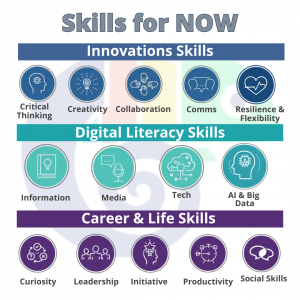
Educational experts group 21st-century skills into three broad categories: learning and innovation skills, digital literacy skills, and career and life skills.
Within these, creativity, critical thinking, problem-solving, and effective communication are emphasised alongside digital competencies like information and media literacy.
The core framework, often called the 4Cs, includes:
- Creativity
- Collaboration
- Communication
- Critical Thinking
These are the foundational learning skills.
The mental processes people need to adapt and grow in a modern working environment.
Beyond these, students also need digital literacy.
The ability to discern facts from misinformation, evaluate sources, and navigate technology responsibly.
And they need life skills.
The intangible qualities that shape how a person moves through the world.
Flexibility, leadership, initiative, productivity, and social awareness.
As education consultant Dr Barbara Kurshan puts it: “Students need the full complement of skills in order to participate meaningfully in our digital world rather than being steamrolled by it.”
What the Data Says: Skills for 2030
These competencies have always mattered, but today, they’re more urgent than ever.
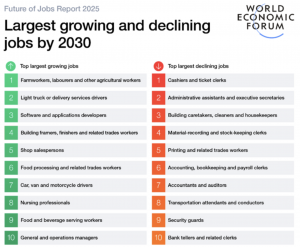
According to the World Economic Forum‘s Future of Jobs Report 2025, approximately 170 million new jobs will be created this decade, while 92 million roles will be displaced, resulting in a net increase of 78 million jobs.
The report finds that 39% of current skill sets will transform or become outdated by 2030, and 59% of the global workforce will need training to meet future labour market demands.
Analytical thinking remains the top core skill employers seek, with seven out of ten companies considering it essential.
It’s followed by resilience, flexibility, and agility; leadership and social influence; creative thinking; and motivation and self-awareness.
As Till Leopold, Head of Work, Wages and Job Creation at the World Economic Forum, put it: “Trends such as generative AI and rapid technological shifts are upending industries and labour markets, creating both unprecedented opportunities and profound risks.
The time is now for businesses and governments to work together, invest in skills and build an equitable and resilient global workforce.”
Notice that none of these in-demand skills is about specific academic content.
Algebra, pre-Columbian history, literary devices, or European geography.
In the 21st century, memorising data and curricula designed around passing standardised tests are no longer enough.
The Disconnect Between School and Reality
Educators and workforce experts alike warn that today’s K-12 classrooms may be overlooking many of the in-demand 21st-century skills students need to succeed.
Without a deeper aptitude for skills not covered in traditional curricula, students will not be set up to compete in the global economy. Envision
The content is already out there.
In a Google search, a YouTube tutorial, or a podcast.
What makes the difference is knowing how to apply that knowledge to solve real problems, develop solutions, and adapt to new contexts.
As educational philosopher John Dewey famously observed: “If we teach today’s students as we taught yesterday’s, we rob them of tomorrow.”
And according to a widely cited estimate, 65% of children entering primary school today will ultimately end up working in job types that don’t yet exist. WEF
Content vs. Skills: What Separates Us from Machines
The Centre for Curriculum Redesign (CCR), after reviewing 111 global frameworks and 861 research papers, identified the competencies most critical in the age of AI, noting that since incremental creativity is now within AI’s reach, the human emphasis must be on imagination.
This is the core insight: technology advances, but human skills remain irreplaceable.
What distinguishes us from machines is our humanity:
- Leadership and empathy
- Imagination and originality
- Adaptability and resilience
- Effective communication and collaboration
- Ethics and responsibility
Business leaders strongly emphasise human-centric skills such as leadership, curiosity, and resilience.
Even as they invest heavily in digital skills like AI, big data, and technological literacy.
World Economic Forum: The future belongs to people who can do both.
Why NovaQuest Academy Does It Differently
At NovaQuest Academy, we don’t focus on filling students with content.
We focus on developing the skills they need to thrive in the future, whatever form that future takes.
We also teach practical, market-ready competencies:
- Computer programming,
- Digital marketing,
- 2D and 3D graphic design, and more.
Because we believe that the best education prepares the whole person, not just the test-taker.

Diana Pineda is an entrepreneur, educator, and author passionate about reimagining education for the next generation. She is the founder of Rhema E-School and NovaQuest Academy. She holds an MBA in Marketing from the University of Greenwich, England. She is a graduate of Universidad Externado de Colombia with a degree in Finance and International Relations and a specialist in Pedagogy and Didactics from Universidad de Medellín.