
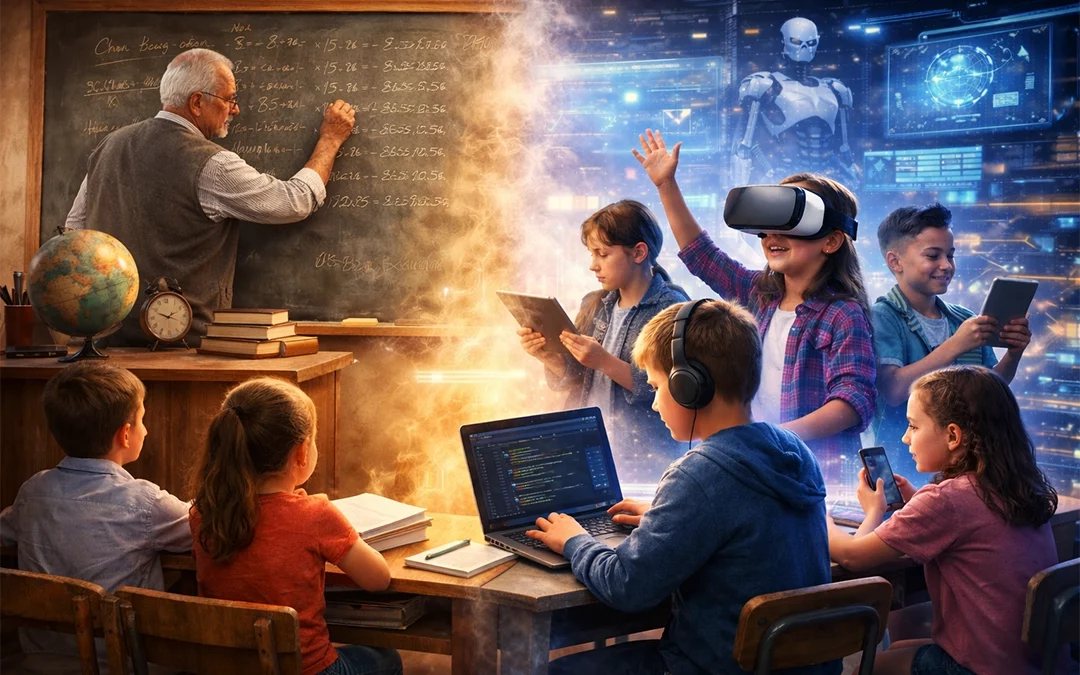
The world has changed faster than anyone expected.
Generative AI, immersive learning, hybrid classrooms, and global connectivity have blurred the line between the physical and the digital.
Children today don’t “use” technology; they live in it.
And yet, education still behaves as if nothing has changed.
We continue teaching the students of the future with the tools of the past.
Why Traditional Schools Can’t Teach Digital Natives
1. Analogue Natives vs. Digital Natives
Today, two worlds coexist:
Analogue Natives
• Silent Generation (1925–1945)
• Baby Boomers (1945–1965)
• Generation X (1965–1980)
In short: anyone over 40.
Digital Natives
• Millennials (1980–1995)
• Generation Z (1995–2012)
• Generation Alpha (2013– )
• And soon, Generation Beta (born after 2025), the first generation raised fully in an AI‑first world.
The difference isn’t just age, it’s perception of reality.
2. Two Ways of Experiencing Reality
Analogue natives grew up in a world without screens.
We played with a ball, a bicycle, or a pair of soda caps.
Photos were taken on special occasions and developed a week later.
Reality was physical: a coffee with someone, in a place, with a real cup.
Digital natives live in a different universe.
They were born into screens, Wi‑Fi, and instant connection.
They watch shows on their phones, play online games, socialise on TikTok, Roblox, Discord, and Snapchat.
For them, Facebook is “for old people.”
Their reality is online, and that changes everything: how they learn, communicate, socialise, shop, create, and even how they fall in love.
3. “This Is the Real World“
One day, during a Zoom class, a student told me:
“Why do you say ‘see you in real life’? This is real life.” — Isabella
For digital natives, screens are not a distraction; they are the environment where life happens.
When adults say things like:
- ‘No phones at the table.’
- ‘Turn off that device.’
- ‘You’ll get square eyes.’
…we are not just setting boundaries.
We are unintentionally disconnecting them from their world.
Most studies warning about “screen addiction” come from analogue researchers.
Yes, there are risks, but there are also enormous opportunities.
Taking a phone away from a digital native is like confining an analogue native during a pandemic: an abrupt cut from freedom, connection, and identity.
If you want to understand this deeply, read Ready Player One by Ernest Cline.
The book (and the film) captures the emotional truth of digital reality.
The Internet Changed Everything… Except Education
Before the internet, education made sense as memorisation.
The student who remembered the most dates, formulas, or capitals was considered “smart.”
But today, every fact in the world is in your pocket, and you don’t even need to spell it correctly because Siri, Alexa, Gemini, CoPilot or ChatGPT will fix it for you.
Yet schools still teach as if Google, YouTube and AI didn’t exist.
They still reward memorisation instead of the skills young people actually need:
- Critical thinking
- Self‑directed learning
- Flexibility and mindfulness
- Digital literacy
- Creativity and problem‑solving
UNESCO (2024) states clearly: “Digital literacy and critical thinking are the pillars of relevant education in the age of AI.”
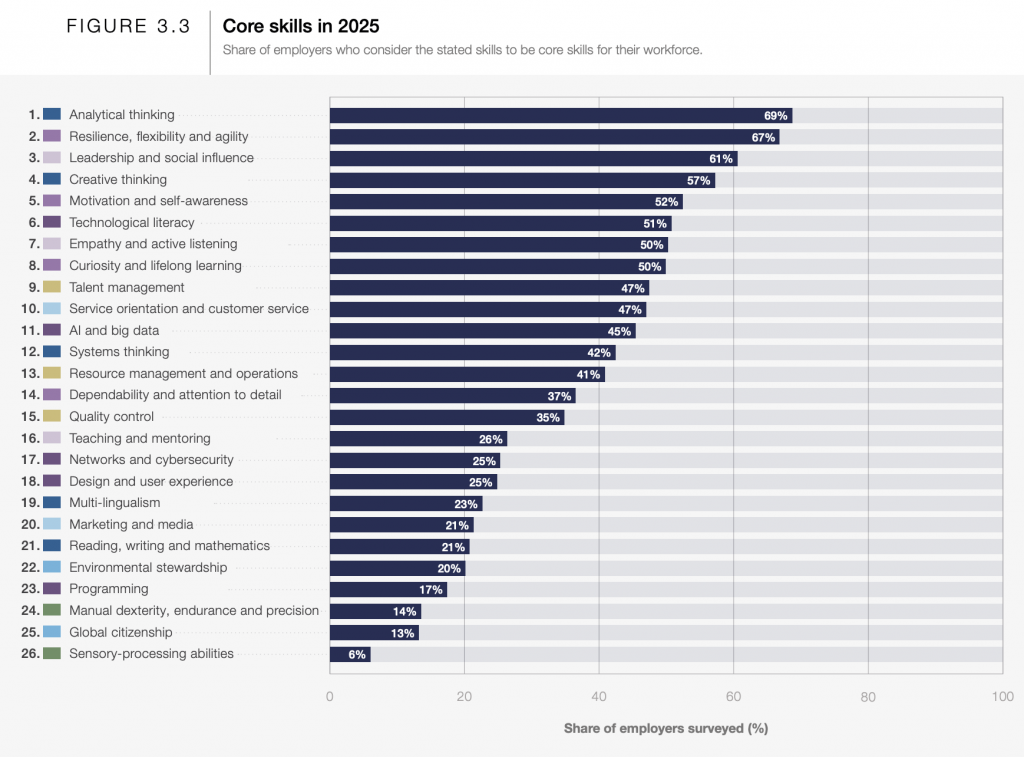
And the World Economic Forum’s 2025 Skills Report shows the same pattern.
The top skills employers need are analytical thinking, resilience, creativity, technological literacy, and lifelong learning.
Not memorisation.
Analogue Teachers Educating Digital Students
Most curriculum designers, textbook authors, and policymakers are analogue natives.
That wouldn’t be a problem if they thought from a young person’s perspective, but they don’t.
They still publish textbooks that are outdated the day they’re printed.
They still design exams that measure memory, not understanding.
They still treat students as passive recipients of information.
But digital natives don’t want to consume content.
They want to create it:
- Podcasts
- Videos
- Games
- Experiments
- Digital projects
- Mini‑ventures
- Articles
- Apps
Schools should teach students to build, not just to remember.
Information vs. Knowledge
Knowing the capital of Mongolia (Ulaanbaatar) is not a skill.
Finding it, understanding it, and using it to solve a problem, that’s knowledge.
Digital natives learn best by doing:
- Reading about volcanoes is good.
- Building one, recording it, posting it on TikTok, and debating it with other kids is learning in action.
Education must shift from memorisation to application.
As I often say: “Education should empower children to be self‑driven learners, independent individuals who can reason, make decisions, and take ownership of their actions.”
The Future of Digital Natives
The future is already here.
Digital natives will work in a world shaped by:
- Artificial intelligence
- Data
- Automation
- Programming
- Global collaboration
Programming languages like Python or Java are not just tools; they are languages of thought.
Traditional universities can’t keep up.
That’s why companies like Google, Apple, and IBM now offer their own professional pathways.
The world no longer rewards memory.
It rewards:
- Analysis
- Communication
- Collaboration
- Creativity
- Experimentation
- Iteration
- Resilience
Exactly the skills the WEF highlights as essential.
Digital Natives in Latin America vs. the UK
This is a perspective almost no one talks about, but it matters.
1. Latin America
- Digital natives often grow up in environments where creativity, improvisation, and entrepreneurship are survival skills.
- They learn to solve problems with limited resources.
- They are naturally resilient and inventive.
2. United Kingdom
- Digital natives grow up with greater access to technology, but within a more rigid academic system.
- They are digitally fluent, but often constrained by traditional expectations.
Two realities, one generation.
At NovaQuest, we bring the best of both worlds:
- The creativity and resilience we’ve seen in our Latin American sister school, Rhema E-School
- The technological fluency and global opportunities of the UK
This combination creates a new kind of learner: globally minded, bilingual, entrepreneurial, and future‑ready.
Toward a New Digital Education
As Sir Ken Robinson reminded us: “Children are not machines to be programmed. They are individuals with imagination, curiosity, and potential.”
Education must evolve.
It must integrate:
- Information
- Skills
- Knowledge
- Practice
- Creativity
- Technology
- Real‑world application
At NovaQuest, we believe education should be lived, not memorised.
That’s why our students build portfolios, launch mini‑ventures, role‑play as CEOs or CMOs, and learn Spanish as a global language.
This is supported by research, such as the BBC’s argument that Spanish is now more useful than French.
We also use frameworks like STARTUP to help children turn ideas into action.
NovaQuest Academy
Launching September 2026. Born in the UK, open to the world.
NovaQuest is the alternative school for digital natives, designed around entrepreneurship, technology, and creativity.
Our mission is simple: To prepare children for the world they will live in, not the world we grew up in.
- If you want your child to learn by doing, thinking, creating, building, and leading…
- If you want them to become independent, confident, bilingual, entrepreneurial, and future‑ready…
Then NovaQuest is for you.
And you don’t have to wait.
Our Latin American sister school, Rhema E-School, is already proving what this model can do (in Spanish).
If you want it in English, then join the waitlist. Or let us converse about your child.

Diana Pineda is an entrepreneur, educator, and author passionate about reimagining education for the next generation. She is the founder of Rhema E-School and NovaQuest Academy. She holds an MBA in Marketing from the University of Greenwich, England. She is a graduate of Universidad Externado de Colombia with a degree in Finance and International Relations and a specialist in Pedagogy and Didactics from Universidad de Medellín.