
One of the most important skills your child will ever develop is not maths, writing, or coding.
It’s decision-making.
Future entrepreneurs, creators, and leaders don’t succeed because someone constantly tells them what to do.
They succeed because they learn how to evaluate options, take action, learn from results, and adjust.
Yet many children grow up waiting for instructions.
From parents and from teachers.
But the truth is that decision-making doesn’t appear automatically.
It must be taught, practised, and modelled.
At NovaQuest Academy, we believe that agency, the ability to think independently, choose intentionally, and take responsibility, is one of the strongest predictors of lifelong success.
And like entrepreneurship, agency grows through experience, not theory.
This article will walk you through a practical, step-by-step way to help your child become a confident decision-maker.
Why do some children struggle to make decisions?
If your child hesitates, changes their mind constantly, or asks for reassurance before every choice, this is completely normal.
Developmental psychology shows that children’s executive functions, such as planning, impulse control, and evaluating consequences, develop gradually through childhood and adolescence.
The brain’s emotional systems mature earlier than its logical reasoning systems, which explains why children often make decisions based on feelings first.
In simple terms:
- Younger children rely heavily on adults to structure decisions
- Emotional impulses often outweigh long-term thinking
- Confidence grows only through repeated practice
What causes indecision?
Usually one of these:
- Fear of making mistakes
- Too many options
- Adults stepping in too quickly
- Lack of experience evaluating outcomes
Entrepreneurial thinking solves this by reframing decisions as experiments rather than permanent judgments.
The entrepreneurial mindset parents can teach early
Entrepreneurs do not wait for certainty.
They:
- Gather information
- Choose a direction
- Test it
- Learn from results
- Adapt
Children can learn this exact process at age five, ten, or fifteen.
The goal is not perfect decisions.
The goal is learning how to decide.
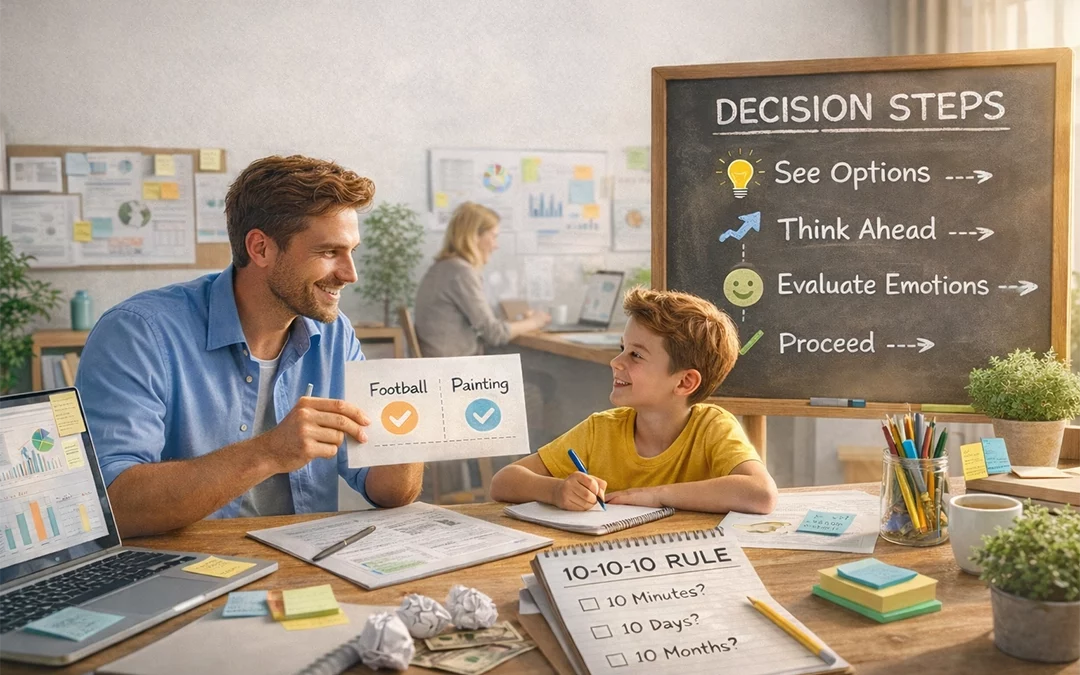
A simple decision framework for families (STEP model)
Here is a practical system you can use immediately at home.
S — See the options
Children often feel overwhelmed because they don’t know how to compare choices.
Reduce complexity.
Instead of open-ended questions, offer structured options:
- “Would you rather try football or painting?”
- “Would you like to start today or tomorrow?”
Limiting options actually increases confidence.
At NovaQuest, this mirrors the Research & Product Development part of our STARTUP framework, exploring possibilities before acting.
T — Think ahead (anticipate consequences)
Strong decision-makers imagine outcomes.
Ask questions like:
- “What might happen if you choose this?”
- “What could be good about waiting?”
- “What could be difficult?”
You’re not telling them the answer, you’re helping them run a mental simulation.
This builds strategic thinking.
Entrepreneurs call this evaluating risk.
E — Evaluate emotions
Research on decision-making shows emotions are not the enemy; they’re part of intelligent choices.
Neurologist Antonio Damasio demonstrated that people unable to feel emotion actually struggle to decide at all.
Teach children to ask:
- “Do I really want this, or do I just feel pressured?”
- “Am I excited or nervous?”
Children who learn emotional awareness make stronger long-term decisions.
This connects directly to Purpose & Leadership in the STARTUP framework; self-awareness drives confident leadership.
P — Proceed and reflect
This is where growth happens.
After the decision:
- Let the experience play out
- Talk about what worked
- Discuss what they would change next time
Instead of saying, “I told you so.”
Try: “What did you learn from that?”
Entrepreneurs call this iteration.
Children call this growing up.
The 10-10-10 rule for kids (an easy tool parents love)
You may have heard of the 10-10-10 decision rule, often used in business leadership.
It works beautifully for children, too:
Ask:
- How will you feel about this in 10 minutes?
- In 10 days?
- In 10 months?
Younger children may need simpler wording, but this builds long-term thinking skills early, a rare skill even among adults.
Daily habits that build decision-making skills
Children don’t become decisive through one big moment.
It happens through small, repeatable habits.
1. Mini daily decisions
Give ownership frequently:
- What to wear
- Which book to read
- Which snack to choose
Small decisions build momentum.
2. Weekly “entrepreneur decisions“
Choose one bigger decision each week:
- Managing pocket money
- Choosing a project
- Planning an activity
Walk through the STEP model together.
This aligns with:
- Accounting & Finance → understanding trade-offs
- Sales & Marketing → explaining choices
- Team & Talent → considering others
3. Reflection conversations
At the end of the week, ask:
- What worked well?
- What surprised you?
- What would you change?
This turns decision-making into a learning loop.
What parents often get wrong (and how to fix it)
Next time, try one of these when your child is making decisions.
❌ Jumping in too fast
Children lose confidence if adults always “save” the decision.
Pause before helping.
❌ Giving too many choices
Too many options create paralysis.
Start small.
❌ Treating mistakes as failures
Children avoid decisions when mistakes feel dangerous.
Reframe: Every decision gives information.
That’s a founder mindset.
How does the STARTUP Framework build agency?
At NovaQuest Academy, we intentionally embed decision-making into everyday learning.
The STARTUP framework develops agency through real-life thinking:
- Sales & Marketing, communicating choices
- Team & Talent, collaborative decisions
- Accounting & Finance, understanding consequences
- Research & Product Development, testing ideas
- Technology & Tools, adapting strategies
- Understanding Customers, empathy and perspective
- Purpose & Leadership, acting intentionally
Children practise decisions in projects, not just worksheets.
They learn to think like builders.
The bigger goal: raising decision-makers, not followers
When children learn how to decide:
- Confidence increases
- Anxiety decreases
- Motivation becomes internal
- Ownership grows
They stop waiting for permission and start shaping their own path.
That shift, from passive learner to active agent, is the heart of entrepreneurial education.
And it starts at home.
Ready to help your child build real agency?
NovaQuest Academy is built for families who want more than traditional education.
Parents who want children to think, create, and lead with purpose.
Explore how our project-based, entrepreneurial learning model helps students grow into confident decision-makers.

Diana Pineda is an entrepreneur, educator, and author passionate about reimagining education for the next generation. She is the founder of Rhema E-School and NovaQuest Academy. She holds an MBA in Marketing from the University of Greenwich, England. She is a graduate of Universidad Externado de Colombia with a degree in Finance and International Relations and a specialist in Pedagogy and Didactics from Universidad de Medellín.