
What can you do as a parent?
1. The Root of the Problem: An Imported, Outdated Model
Education in Britain was not originally designed to nurture free thinking.
Surprising as it may seem, today’s UK school system owes a great deal to the Prussian model, an approach to mass schooling developed in 19th-century Germany following Napoleon’s defeat of Prussia.
Determined to rebuild a more obedient, controllable population, Prussian leaders designed a compulsory system built around regimented classrooms, rote memorisation, strict hierarchy and unquestioning compliance.
Britain adopted the essentials of this model when compulsory schooling was finally introduced in the 1880s.
Victorian reformers, inspired by reports on Prussian schools that circulated through France and then England, built a system that valued order, uniformity and measurable attainment over creativity or independent thought.
Uniforms, bells, rigid timetables, year groups and standardised exams all echo that original Prussian blueprint.
Over 140 years later, we are still largely running the same system.
The result?
- Children and young people who learn to reproduce content in order to pass exams, but not to question, create or solve real-world problems.
- Obedience is valued over curiosity.
- Memory is rewarded over imagination.
- Mistakes are penalised rather than treated as opportunities to learn.
Which raises an uncomfortable question: who benefits from a society that does not question?
The systems of power prefer citizens who “obey and work” to those who think, innovate, and build.
Rather than producing leaders and creators, we continue to produce employees shaped for a world that no longer exists.
For a vivid example of what happens when this mentality goes unchallenged in government, look at the United States President Donald Trump.
His conduct in office has repeatedly illustrated the consequences of ideological rigidity over genuine critical thinking.
The lesson is universal: when a system discourages real inquiry, the results eventually speak for themselves.
How does this model show up in classrooms today?
- Memorisation over critical thinking.
- Students are taught to repeat what they are told, not to analyse, debate or question.
- The teacher is the sole authority.
- Lessons revolve around delivery from the front, not what the student can explore, discover or create.
- A rigid, uniform curriculum.
- All pupils are expected to learn the same content at the same pace, with little room for individual interests, talents or learning styles.
- Uninspiring environments.
- Long days, repetitive tasks and a persistent disconnect from real life.
Governments favour stability over disruption.
Many employers still want compliant workers, not creative minds.
A society that does not question is easier to manage.
And so, decade after decade, we import innovation rather than produce it.
2. The Visible Consequences: Fewer Breakthroughs, More Box-Ticking
When education is built on repetition rather than creation, the consequences ripple through society as a whole.
In the UK and across Europe, the data is telling:
The UK filed just 6,076 patent applications at the European Patent Office in 2024, ranking 9th in Europe, according to the EPO’s Patent Index 2024.
That represents a fraction of the global total, well behind innovation leaders like Germany, France and the Netherlands.
While EU R&D intensity averaged 2.24% of GDP in 2024, with Sweden at 3.6% and Germany at 3.1%, the UK has struggled to meet its own government target of 2.4%, a gap that reflects a systemic underinvestment in the conditions that produce innovation.
The OECD’s Director for Education and Skills, Andreas Schleicher, has pointed out that the UK has one of the highest rates of memorisation-based teaching among developed nations, and that the very skills easiest to teach and test are “exactly the skills that are also easiest to digitise, automate and outsource.”
Research by Nesta found that despite broad recognition of the importance of creativity and critical thinking, UK policy and funding have “not yet caught up.”
Meanwhile, 42% of UK creative industry employers report a skills gap, according to industry data.
Why is this happening?
Because we are training students to memorise and pass exams, not to develop new ideas.
Rather than encouraging young people to question, investigate and experiment, we reward compliance with the curriculum, not the creativity to transform it.
The system keeps preparing young people to be employees who follow instructions, not entrepreneurs who build solutions.
What if we changed that?
Teaching entrepreneurial thinking from an early age is not a radical idea.
It is an urgent necessity.
Curiosity and divergent thinking must sit at the centre of learning, not be squeezed into the margins.
We need to stop replicating the past and start generating new knowledge: from local realities, from what children and young people actually live every day.
Without innovation, there is no progress.
And without an education that liberates, there is no innovation.
3. The Classroom as a Factory: Uniformity Over Identity
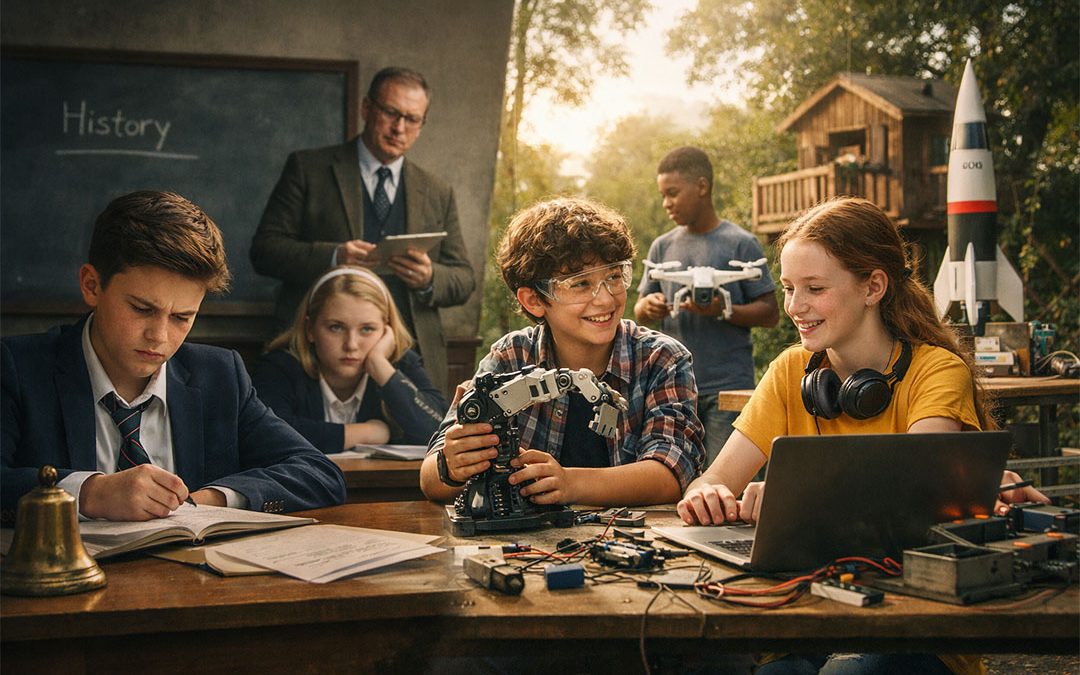
The traditional education system continues to treat pupils like products on an assembly line: same content, same pace, same assessment.
This “one size fits all” approach completely ignores individuality, different learning rhythms and each child’s unique talents.
Rather than discovering and developing those abilities, the traditional model trains children to repeat and comply.
What happens to the child who shines in technology, music or art?
Or the ten-year-old who already has ideas for a business?
They simply don’t fit.
And worse, they are made to feel that their way of learning is somehow wrong.
This disconnect between school and the world, a world that demands creativity, critical thinking and digital fluency, leaves millions of young people poorly prepared.
Schools still speak in terms of grammar rules, capital cities and memorised formulas, while the world of work and technology evolves at an extraordinary pace.
At NovaQuest Academy, we have built an alternative that respects and develops individual talent.
Whether a student wants to become a programmer, a designer, a content creator or an entrepreneur, they will find a space to grow here, not a mould to fit into.
4. The Silent Damage: An Education That Extinguishes Curiosity
Most children start school with bright eyes, full of questions and a genuine eagerness to explore.
Year after year, that spark gets dimmed.
As Sir Ken Robinson observed, creativity falls sharply with every additional year of traditional schooling.
The message children absorb is clear: don’t think differently, don’t ask too many questions, don’t step outside the lines.
The UK does not need more ‘mental factory workers.’
It needs thinkers, creators and problem-solvers.
Young people who can adapt and who can also imagine entirely new paths.
People capable of building businesses, leading communities and inventing what comes next.
In the 21st century, educating differently is no longer an eccentricity.
It is a necessity and urgent.
5. It’s Already Working, See For Yourself
NovaQuest Academy is the UK sister school of Rhema E-School, a pioneering online school in Colombia that has been proving this model works for years.
Here is what becomes possible when children are trusted to think, create and lead:
- Juan José was stuck and falling behind in the traditional system. Within three years of joining Rhema E-School, he had graduated and was working at his local council.
- Carlos and Santiago launched their first real project together: a fully playable video game, built, designed and presented by them.
- Carlitos creates clay sculptures that he presents to professional judging panels at creativity fairs, with the composure and confidence of a seasoned professional.
These are not outliers.
This is what education looks like when it trusts children enough to let them lead.
6. What Can You Do?
Change will not come from traditional institutions or from government alone.
It will come from bold parents who decide to break with the obsolete.
Parents who say:
“My child did not come into the world to memorise and repeat.
They came to think, create and make a difference.”
The good news is that a real alternative already exists.
At NovaQuest Academy, we combine the best of modern pedagogy with the flexibility families need today:
- Personalised education tailored to each child
- Real-world projects with genuine outcomes
- Digital skills and technology at the core
- Bilingual learning
- Mindfulness and wellbeing
- A focus on entrepreneurship, arts and innovation
At NovaQuest Academy, we don’t just want your child to pass.
We want them to think, create and transform.
Because the future is not something you memorise.
It is something you build.
→ Join our waiting list today.
We open in September and are accepting students until 31st July.
Spaces are limited; secure your child’s place now.

Diana Pineda is an entrepreneur, educator, and author passionate about reimagining education for the next generation. She is the founder of Rhema E-School and NovaQuest Academy. She holds an MBA in Marketing from the University of Greenwich, England. She is a graduate of Universidad Externado de Colombia with a degree in Finance and International Relations and a specialist in Pedagogy and Didactics from Universidad de Medellín.