
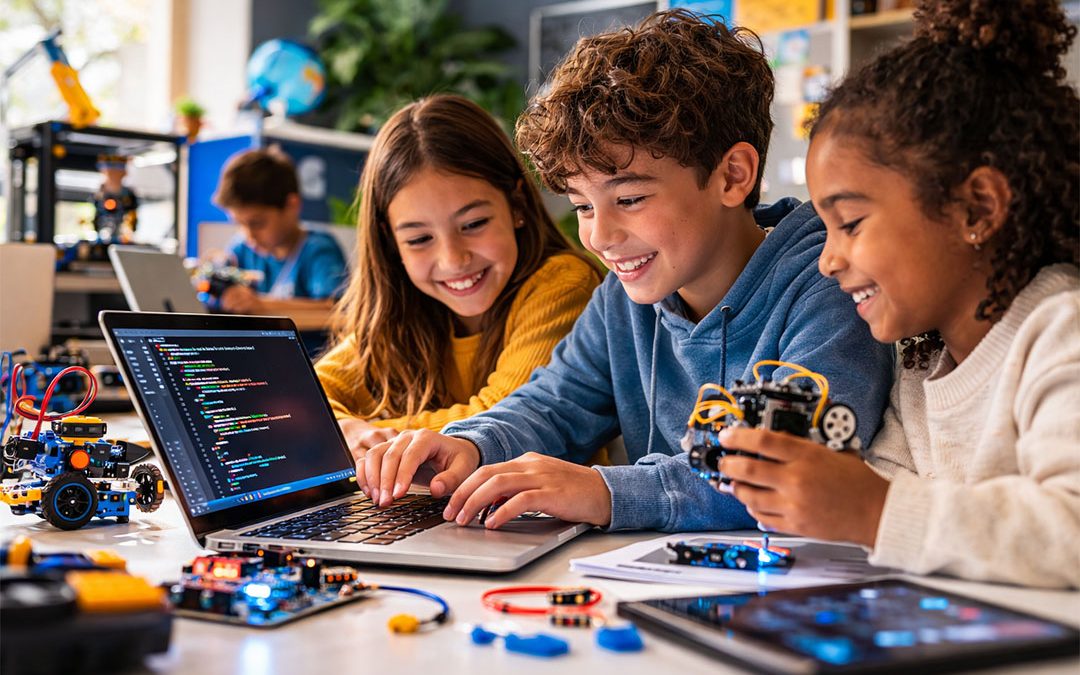
Learning to code used to be something only engineers did.
Today, anyone can learn, even a preschooler.
In the 1980s, when I attended computer class at school, we sat in front of those old 286 computers that, to our generation, looked like something from the future.
We learned Word, Excel, and, if we were lucky, PowerPoint on Friday.
It felt fascinating… within its limits.
There was no internet.
No collaboration.
No creativity.
Just a grey screen and a keyboard where we practised typing.
More than thirty years have passed, yet many schools still teach computing almost exactly the same way.
And that’s the problem.
If we want Generation Z and the generations that follow to thrive in the world they are entering, coding must become a core part of education, not an optional subject.
Make yourself a coffee or tea. This gets interesting.
What Is Coding?
Coding is simply the language we use to communicate with machines.
As Michael Aguas, a programming teacher at Rhema E-School, our sister school in Latin America, explains:
“Programming is a series of algorithms and patterns that tell a program what tasks to perform and how it should behave.”
But programming isn’t as mysterious as it sounds.
In everyday life, we follow sequences all the time.
Michael starts his lessons with an example as simple as eating soup.
If you turned that into a program, it would look like this:
Decomposition
Pick up a spoon → dip it into the soup → bring it to your mouth.
Algorithm
What happens first? What repeats?
Pattern
Repeat the sequence until the soup is finished.
Children love this example because they quickly realise that programming isn’t magic.
It’s logic applied to real life.
Once they understand that foundation, they can explore programming languages, artificial intelligence, data science, and machine learning.
But every journey begins with that first logical step.
Coding in Schools: A Missed Opportunity
After the pandemic, schools everywhere filled their classrooms with laptops, tablets, and digital tools.
It looked like the perfect moment to transform computing classes.
In many places, however, nothing really changed.
Teaching Word and Excel remains easier.
It’s cheaper.
And it stays inside many schools’ comfort zones.
But that approach doesn’t prepare children for the world they are entering.
In 2013, Barack Obama publicly supported the Code.org initiative “Hour of Code”, encouraging students to learn the technologies shaping the modern world.
Silicon Valley, start-ups, automation, and artificial intelligence, none of these exist without programming.
Michael often tells his students:
“Mark Zuckerberg started coding as a child. Our role as teachers is to spark curiosity about what machines can do to improve life.”
When children explore areas like:
- App development
- Website creation
- 3D design
- Artificial intelligence
They develop something deeper than technical knowledge.
They develop computational thinking, the ability to recognise patterns, solve complex problems, and invent solutions the world hasn’t imagined yet.
Why Coding Matters for Children
1. Coding Teaches Problem-Solving
Children today grow up surrounded by information, trends, and social media influence.
They need the ability to think logically and make sound decisions.
One of the core principles of programming is decomposition: breaking a complex problem into smaller steps.
This mental habit strengthens reasoning skills and structured thinking.
Research in cognitive science suggests that learning how technology works can:
- Strengthen cognitive flexibility
- Improve memory and fluid intelligence
- Develop analytical reasoning
In other words, coding doesn’t just teach technology.
It trains the brain.
2. Coding Builds Resilience
Programming involves making mistakes, often many of them.
Unlike traditional education systems that penalise errors, coding treats mistakes as part of the learning process.
Debugging is simply learning through iteration.
Michael recalls a lesson where his primary students were asked to design a table in TinkerCad using only code.
At first, many said, “I can’t do it.”
But after trial and error, they succeeded.
And they discovered that failure isn’t the end of the process.
It’s part of how learning works.
3. Coding Awakens Creativity
To introduce younger students to programming logic, Michael created a mini-escape-room activity.
Students had to help an artificial intelligence escape a locked room by arranging instruction cards in the correct sequence.
Without realising it, they were learning to:
- Think in logical sequences
- Create algorithms
- Work collaboratively
- Solve puzzles through experimentation
Seven-, eight-, and nine-year-olds were thinking like programmers.
They simply experienced it as a game.
4. Coding Makes Maths Come Alive
Mathematics sits at the heart of computer science.
Logic, patterns, algorithms, and structures all rely on mathematical thinking.
Michael once turned a running classroom joke, his dream of buying a gaming PC, into a coding exercise.
Students wrote a Python program to calculate whether he could afford it.
Along the way, they learned:
- Applied arithmetic
- Variables and conditions
- Real-world price comparisons
- Hardware components and computing systems
Most importantly, they had fun doing maths without feeling like they were doing maths.
5. Coding Is One of the Most In-Demand Skills
According to Code.org, around 71% of jobs in science, technology, engineering, and mathematics require coding skills, yet only a small percentage of graduates master them.
The gap is enormous.
That means a student who learns to code early already holds a meaningful advantage in fields like:
- Technology
- Finance
- Healthcare
- Sales and marketing
- Entrepreneurship
- Data-driven industries
Michael often sees students independently creating games and animations in Scratch without being told exactly which blocks to use.
That level of autonomy, creativity, and logical thinking doesn’t happen by accident.
It’s trained.
Coding and the Skills of the 21st Century
Coding touches nearly every capability children need for the future:
- Critical thinking
- Creativity
- Collaboration
- Communication
- Digital literacy
These skills sit at the heart of what modern education should develop.
And they align closely with the philosophy behind NovaQuest Academy.
Coding at NovaQuest Academy
At NovaQuest Academy, coding isn’t treated as an isolated subject.
It becomes part of a broader learning ecosystem that combines:
- Project-based learning
- Technology and AI literacy
- Entrepreneurial thinking
- Real-world problem solving
Students don’t just learn to use technology.
They learn how to create with it.
They design apps, build digital products, analyse data, and explore how technology can solve real problems.
The goal isn’t to turn every child into a programmer.
The goal is to help them understand how the modern world works, and how they can shape it.
Final Thoughts
Without programming, you wouldn’t be able to read this article.
Your phone wouldn’t work.
Your television wouldn’t turn on.
Most modern systems would simply stop functioning.
Coding opens doors.
It expands horizons.
And it transforms ideas into reality.
When children learn to code, they:
- Understand the technology around them
- Develop logical and creative thinking
- Solve problems step by step
- Build real apps, games, and solutions
Some studies even show that professionals with coding skills can earn significantly higher salaries than those without them.
So the real question becomes: Why wait?
If you’d like your child to explore this world early, join the NovaQuest Academy waiting list and discover a different way of learning for the digital generation.

Diana Pineda is an entrepreneur, educator, and author passionate about reimagining education for the next generation. She is the founder of Rhema E-School and NovaQuest Academy. She holds an MBA in Marketing from the University of Greenwich, England. She is a graduate of Universidad Externado de Colombia with a degree in Finance and International Relations and a specialist in Pedagogy and Didactics from Universidad de Medellín.